Tuesday, April 26, 2016

Beginning of Mindfulness

In our world today, staying present can be a struggle. Our to-do lists grow longer and we have a lot of responsibilities to uphold. Being mindful is not one that makes the top of that list. One way to think of mindfulness is that you are being present in this moment of time; not thinking in the past or to the future of what should be done. One of the only things that are in this moment are our senses. If you catch yourself drifting off into the future or ruminating on the past think through the five senses and tell yourself: 
  • What are 5 things I see?
  • What are 4 things I can touch?
  • What are 3 things I can hear?
  • What are 2 things I can smell?
  • What is 1 thing I can taste?
Our senses can only be felt in the present. Going through the five senses can help bring us back to this present moment and remind us to live in the here and now. Our friends are in these moments, are families and our children. Ruminating on the past will not change it and worrying about the future will not change what God has in store for us. Let’s enjoy the beauty of the day that God gave us today.

By: Sam Hicks, LPC

Wednesday, April 20, 2016

Avoiding the Disconnect

My previous post (found here) focused on the lack of connection that technology has created in our world, and I urged parents to not allow technology to be the reason for a disconnect in the family. I recognize this is something easier said than done. The world constantly pulls us towards technology use. Technology is attractive, luring, and consuming. Parents who do no want technology to cause a relational disconnect in their families need to strongly consider implementing boundaries and guidelines that foster connection. 

So just how can parents go about developing relational connections with their children apart from technology? Conversation leads to connection, so my ideas center around creating the space for healthy conversation surrounding technology use and healthy conversation apart from technology use. Allow me to explain a few of my ideas, and as you read, think about how these things might result in a stronger connection with your child. 

First, set an example for your children to follow. Your limitations of personal technology use will model implementation of appropriate boundaries. Instead of stopping a conversation with your child to respond to a text message, give your child your full attention and wait until the conversation is over to respond. When having conversations with your child, silence your phone and put it away so that it is not a distraction. Teach your child that they do not need to have a device in their hand 24/7 by not having a device in your own hand 24/7. Parents who respond the second their phone buzzes teach their children to do the same. If you do not want your child to be using his or her phone all of the time, set the example. Place high priority on healthy conversation habits which include eye-to-eye contact, deep listening, and minimal distraction. 

Second, implement technology-free zones and/or times. Create a rule that phones are not allowed in a certain room or place like at the dinner table to remove distractions that might hinder family conversations. Make sure that all phones and devices are kept out of the technology free zone to minimize the temptation for distraction. Instead of a technology-free zone, parents could ick a night of the week where phones are put away for a certain amount of time. I like to call this a technology hiatus. Use the technology hiatus to engage in quality time and conversation. Do something together as a family that fosters connection. 

Third, discuss expectations for technology use. Clearly explaining appropriate boundaries for the use of technology makes it easier to enforce expectations. Kids flourish when they understand what is expected of them. Setting boundaries allows for easy implementation of consequences when children choose to not follow the rules. Are video games allowed only on certain days of the week? Is there a curfew of when technology is no longer allowed? Is your child expected to exhibit a certain code of conduct of social media? Share all of these things with your child so that they know what the rules surrounding technology are. Establish clear guidelines that place limits on use and stick to the boundaries. 


Doing these three things can dramatically alter the course of your family’s pathway to disconnection. Catherine Steiner-Adair says this in her book The Big Disconnect, “Kids thrive in the context of really good relationships with their parents, and never before has technology challenged that relationship and that direct in-vivo connection as much as it does today.” Technology will only create a relational disconnect in your family if you allow it. The payoff of a good relationship with your child is profound. Are you in?

By: Amanda Paben, LPC

Sunday, April 17, 2016

Digital and Disconnected

This is the first blog post in a series of articles on the impact of technology in families. This post will address the impact upon relationships caused by technology and pose important questions for families to consider. 

Did your child or spouse receive an iPod, smartphone, or video game system for Christmas? Then I have something I would like for you to ponder as you look forward to a new year: what impact will that gift be allowed to have on your family in this upcoming year? 

A while back, I came across a photo in my Facebook news feed that I have had a hard time erasing from my mind.  (Of course when I went back to look for it, I couldn’t find it.) The picture showed a couple lying in bed both using different devices. In between them was a picture of a giant iPad essentially acting like a wall between them. That picture got me thinking about the impact of technology upon families and relationships.  I admit that I am guilty of using my phone or checking e-mails when I should be spending quality time with my husband, but since seeing that picture, I have found myself questioning just how much of a divide technology has created.  

Technology has infiltrated our world. There is almost always an e-mail waiting for a response, a call that needs to be answered, or a text to check. Add in playing games, updating a twitter page, checking Instagram, and all of the other things that technology can do, and we are left with an overwhelming pull towards the digital world. I challenge you to go out to any restaurant and pay attention to the surrounding families or couples. Watch their interactions for a little while. It will not take long before one starts to notice the large amount of tables where there is no interaction taking place simply because everyone is on a phone or device.  

Children today are growing up in a world far different from the world their parents grew up in because of the growth of digital devices. While there are several great benefits of technology, some are also starting to recognize several problems caused by technology. Kids today are growing up in a world where there are lot of online connections but few, if any, deep relational connections. Relational connections start in the home, and it is the job of a parent to provide the foundation for those connections. Children who are unable to make relational connections will have problems later on in life. While the surge of technology and the digital world are not solely responsible for straining relationships, I would argue that they do impact a person’s ability to be present and engaged in conversation. Over time, technology has seemed to reduce, if not replace, one’s ability to spend quality time (undistracted, intentional time) with loved ones. 

Catherine Steiner-Adair in her book The Big Disconnect writes the following:
Parents who have long-prided themselves in protecting, providing, and promoting a values-rich childhood for their children are feeling increasingly irrelevant in their children’s technology-driven lives. And they are right. Parents have lost their job—sometimes unwittingly abdicated it—at a time when they are most desperately needed by kids who are not only growing up faster but growing into a world that no longer protects children. 

When I read books like The Big Disconnect, I feel overwhelmed with the rapid shift that has taken place in our society. I still remember wondering why in the world my friends would want to be able to check their e-mails on their phone when smart phones first came onto the scene, and now I cannot imagine being unable to access my e-mail on the go. Do not get me wrong, I think technology has a lot of benefits, but I wonder if we have really taken the time to consider the impact on the family. What are children learning if they have to compete with a phone for their parent’s attention? What is the impact upon marriages and families when spouses are more concerned with scrolling through their Facebook feed rather than connecting with one another? Are you willing to allow a disconnect to happen in your family?

Parents, it is time to take your job back. I urge you to not be the parent who willingly gives up his or her job of protecting and connecting with the child in your home because of the work emails that need to be answered or the levels of Candy Crush that need to be conquered. Technology is causing great division in families and relationships, and if families are not careful, it will eventually cause a complete disconnect. Are you willing to let that happen? 

Stay tuned for my next post which will address some strategies to bridging the gap between relationships and technology. 

By: Amanda Paben, LPC


Thursday, April 7, 2016

Control, Part 2

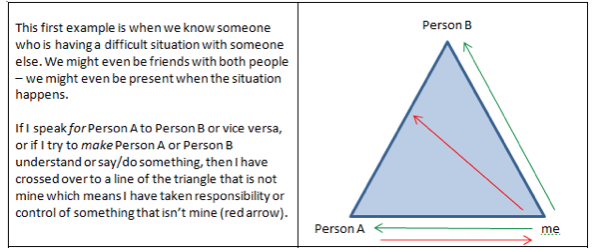
In my last article (Control Part 1) I wrote about having a healthy sense of control while accepting the things we can’t control. Part of having a healthy sense of control is remembering that healthy control doesn’t need to take control or power from someone else – it doesn’t try to control other people. Part of accepting the things we can’t control (other people and some situations) is to remember that we always have control of our response. This article is a continuation of that by providing a basic test for whether we are overstepping control when dealing with other people. 

Test for Healthy Control  
In each example, I am only responsible for and can only control the arrow that extends from me for the line of the triangle that touches me (the green arrows). I am not responsible for, and should not try to control the line that does not touch me or originate with me (the red arrows) – if I do then I have tried to take control/power/responsibility of something that isn’t mine.


Healthy control realizes there are some things that we have control over and some things that we don’t. It causes us to take ownership for our interactions, responses, and growth. While we can speak into the lives of those who have given us permission to speak into them, healthy control does not overstep its bounds in either taking responsibility for things it is not responsible for or in doing things to make another person do or not do something. This means we can say what we think, feel, need and want, but accept the other person’s decision. In situations where their decision impacts us negatively, then we take control of our response and do what we need to keep ourselves safe or meet our need. Healthy control doesn’t need to take control from someone else. 

By Adrienne Kather, LPC

Friday, March 25, 2016

Control, Part 1

What comes to your mind when you hear the word control? Is it positive or negative? Do you think about the control (or lack of) that you feel you have in your life? Do you think about people you would consider to be controlling? Control can be positive or negative, depending on how we use it. In fact, we need to feel we have some level of control over our lives in order to take responsibility and have motivation.  

When I first learned about the idea of locus of control (the degree to which we perceive we have control over events), I learned about it in two extremes. On the one extreme was feeling that we had control over results and situations in our lives (internal locus of control). The other extreme was feeling that fate or others determine the results (external locus of control). 

Recently I read we now know that locus of control actually happens in a spectrum rather than just two extremes – which seems more accurate and healthy. If we rigidly held to one extreme or the other we’d be believing what’s called a control fallacy – either seeing ourselves as helpless to others and/or fate, or seeing everything that happens as a result of something we did. The reality is there are some things we can control and some things we can’t control. One thing we can always control (even when we’re in a situation that we can’t control) is our response. One thing that we cannot control is other people. 


Next time you’re in a situation that is affecting you negatively, try to become aware of your perspective – are you thinking you have control or don’t have control – then examine how accurate your original thought is. Sift through what aspects you have control of and what aspects you don’t. Remember that you always have control over your response. Sometimes that might mean finding another way to meet your need or address hurt when the other person in the situation won’t change. Remember that healthy control doesn’t need to take control from someone else. My next article will give some practical examples of when we step into controlling others (often unintentionally) and what we can do differently in those situations. 

By: Adrienne Kather, LPC

Wednesday, March 16, 2016

Selective Environment and Self Nurture

Is this the old Nature vs Nurture argument again?  Not really.  We all have a past.  We can't change our past.  Our parents are who they are, and they raised us in a certain way, which no doubt has implications on who we've become. Additionally, genetics are difficult to change.  Studies show that having family members with depression increases our predisposition to such conditions.  But this paints a pretty grim picture for those who have parents who struggle with one thing or another and for those who grew up in not such a nurturing environment.  So is there any hope? YES!

We can't change what we have experienced in our past or our genetics however, we can create for ourself a positive, nurturing environment.  We can choose the people we spend time with and what we do in our leisure time.  No one is making us binge watch The Walking Dead on Netflix in order to get ready for the upcoming season instead of doing something more in line with our purpose and passion.  There is no force making us hang out with a friend who is consistently putting us down, has a consistently negative attitude or other provides other various bad influences.  But sometimes we get so defeated that it seems as though we have no other options.

We also have the ability to nurture ourselves.  The media gets blamed so much for the negative information we have to deal with ad nauseam.  However, the media does not get to choose what we do with that information.  For many this information is unintentionally taken to heart, and we think, "Yes, I would be much cooler with that new watch that I can read my text messages with, I need to get that!"  Perhaps an extreme example but I think it helps get to a bigger point.  We all are receiving messages every day either from peers, coworkers, parents, or ourselves.  Some of us are not very savvy on denouncing these messages.  We allow false or half-truth messages become our actual truth, which can develop into anxiety or depression.

What half truths have you been taking to heart?  What are some ways you could nurture yourself better?  What changes in your environment can you make in order to lead a more authentic life?

By: Nicholas Smith, MA, LCPC


Tuesday, February 23, 2016

The Counseling that God Provides

One of the names of God is Wonderful Counselor. He really is and He speaks to us through many forms of communication. A walk in the woods on a snowy day cries out the beauty and majesty of God. A day at the ocean can do wonders for the soul and echoes the immense power of our Lord. A new born baby or the love of someone who really cares can warm our hearts and give us the hope of God’s love in an often dark, cruel world.
One of the main ways that God communicates to us is through His Word. Sometimes we may read a Bible passage and not feel the love and comfort that we’re supposed to receive. Reading can feel like just going through the motions. That is when I have found that praying before reading any further can really help. I ask God to open my heart to His Word, to show me what He wants me to learn and to prepare my heart to receive insight and understanding of the passage. 
Psalm 27 is an example of a great reading when feeling anxiety or fear. It is a confidence builder, written by David, who knew the real threat of war and violence. He continually turned to God, during good times and bad, and was called a man after God’s own heart. He sought the Lord when his life was in danger, when life seemed hopeless, and when he was filled with the grief of his own sin. And through his writing it can be seen that he was encouraged and uplifted by the Holy Spirit. 
The first 2 lines of this psalm are inspiring and remind us of where our strength comes from.
“The Lord is my light and my salvation – whom should I fear?                                                                  The Lord is the stronghold of my life – of whom should I be afraid?”
The third verse is one which can remind us that with God on our side, we can feel secure no matter what happens.
“Though an army deploys against me, my heart is not afraid;                                                                                      Though a war breaks out against me, still I am confident. “
God is not only powerful to protect us, He is also amazingly creative and artistic. He truly is the Master Artist and Designer, from Whom the world gets all the ingenuity and talent ever experienced. If we reflect, as David does in verses 4 and 5, on God’s beauty and incomprehensible love for us who are small, weak and dependent on the very air we breathe, we would be fools not to put all our hope and trust in Him.
“I have asked one thing from the Lord; it is what I desire: to dwell in the house of the Lord all the days of my life, to gaze upon the beauty of the Lord and seek Him in His temple.                                            For He will conceal me in His shelter in the day of adversity; He will hide me under the cover of His tent; He will set me high on a rock.”
David shows us that we can ask anything of the Lord and though we may have to wait, He is faithful to work things out. He will revive us, restore us and give new hope and strength when we need it. Sometimes friends or family disappoint us, we may have people in our lives who want more from us than we are able to give, or have difficult circumstances to endure. David seems to have experienced all these things and more. And he was not ashamed or afraid to cry out to God in any adversity. In doing so, he found the assurance he needed as displayed in verse 10, 13 and 14.
“Even if my mother and father abandon me, the Lord cares for me."
“I am certain that I will see the Lord’s goodness in the land of the living.”
“Wait for the Lord; be strong and courageous. Wait for the Lord.”
David trusts God and God lifts his spirits so that he can face the day and whatever is in front of him.  He did not necessarily get answers to all his questions or what he wanted when he wanted it. Yet he had the solution to His wrestless heart.  We too can have that encouragement, hope and confidence, by spending time with the Lord, believing His Word and sharing David’s heart of faith and trust in the Great God who loves us and gave his life for us so that we may live through Him.

By: Francine Costanza, LCPC