Thursday, July 7, 2016

Everyday 12 Steps, Part One

The 12-steps were designed originally for men struggling with an addiction to alcohol. Over the years these steps have been applied to many other addictions and struggles and can be used by anyone. Many people who work the steps say that steps one through three are steps that should be done on a daily basis. In the 12 steps for Christians, step one states:
We admitted we were powerless over the effects of our separation from God-that our lives had become unmanageable
We come into this world with the seed of sin already in us due to the fall. It does not take long to look into this world or at the news and see the sinful nature of humans. This can be extremely defeating to look at. We have immense amounts of hope, however, because we know that God has an amazing plan for us and He will win in the end.
Romans 7:18 is a verse paired with this step that states: “I know nothing good lives in me, that is, in my sinful nature. For I have the desire to do what is good, but I cannot carry it out.”
On a daily basis, we can admit that our lives are unmanageable and we cannot carry out the good we would like to without the help of God. This may sound very disempowering and feel as though we are failing. However, God is great! When we admit this powerlessness we are made strong in Him. This power is greater than any human strength we can muster.
God can and will carry out His good works through you and will give you the strength to face any challenge that you face today.

By: Sam Hicks, LPC

Thursday, June 16, 2016

Leaving A Legacy

… From everlasting to everlasting the Lord’s love is with those who fear Him and His righteousness with their children’s children, with those who keep His covenant and remember to obey His precepts.       Psalm 103:17
Psalm 103 is one of my favorite Psalms. Reading it this morning reminded me of how much I want to leave a legacy of love to my children. That desire motivates me to regularly examine my life, what I am doing and how I am living. It causes me to consider my priorities and values and how I order my days. From this Psalm I am made aware of how much I need the Lord in order to truly love on a consistent basis, to love when I don’t feel loving and when others don’t feel lovable! 
According to Proverbs 9:10, “The fear of the Lord is the beginning of wisdom,” and Psalm 103:11 says “For as high as the heavens are above the earth, so great is His love for those who fear Him.” Fearing the Lord may not sound desirable and may even feel frightening in itself. But I think it is necessary in order for God to get our full attention. Otherwise we tend to go our own way, disregarding the invisible God who made us and how important He is to our very existence. It is humbling to think of the sin nature we struggle with and our very breath being dependent on Him. Understanding our own weakness and God’s awesome power hopefully brings us to our knees. It is there that we can experience God’s perfect love which casts out fear and fills us with the mercy and grace He has for us. Suddenly we see that God does not want to harm us but to heal and help us. Christ’s death and resurrection can now make sense as we turn to God in our limited humanity. When we sincerely turn to Him in humility, we find a loving Father who as David says, “has compassion on those who fear Him; for He knows how we are formed, He remembers that we are dust” and “from everlasting to everlasting the Lord’s love is with those who fear Him and His righteousness with their children’s children with those who keep His covenant and remember to obey His precepts. “
And what are His precepts (instructions)? I love the verse in Micah 6:8 which says, “…And what does the Lord require of you but to act justly and to love mercy and to walk humbly with your God.” Jesus stated it succinctly in Matt. 22:37, 39; “Love the Lord your God with all your heart and with all your soul and with all your mind… and love your neighbor as yourself.” Two simple commands but they’re often very hard to carry out. The best way I have found to set my mind toward them is by spending time in that secret place with God, in His Word and in communion with Him. The term “secret place” is found in Psalm 91:1 of the New King James version where David says, “He that dwells in the secret place of the Most High shall abide under the shadow of the Almighty.” Verse 2 states “I will say of the Lord, He is my refuge and my fortress: my God; in Him will I trust.” In that secret place with God, David realized God’s amazing power and love, his own weakness and God’s great compassion and love for him, a mere mortal with inconsistent motives and often little control over them. 
Praise is the natural and irresistible outcome of connection with the Lord. And it is after time alone with Him in His Word and prayer that Psalm 103:1 becomes the cry of our own hearts;
Praise the Lord, O my soul; all my inmost being praise His holy name. 
How, you may be asking, does this tie in with leaving a legacy of love? Well, as I leave that place of sheltered time with the Lord, I try to make it a priority to abide in Him as I go about my day.  Jesus told us in John 15:4 “Remain in Me and I will remain in you. No branch can bear fruit by itself; it must remain in the vine. Neither can you bear fruit unless you remain in Me.” As I go about my day, I try to  maintain the awareness of God’s presence and His ever present help. When I feel uncertain or need to make a tough decision, or when my emotions start to get the best of me, I need to call on Him and ask for strength, patience and discernment so that my interactions with those I love can be in line with my love for them. When I feel my old sin nature creeping in (which believe me is more often than I like to admit), it’s time to check in with God our Father, because my abiding has slipped away into aligning with something contrary to His will.
Clearly I do not accomplish this 100% of the time. Sometimes I come to God in disappointment over my less than perfect approach or reactions. Thankfully our God “does not treat us as our sins deserve or repay us according to our iniquities” (Psalm 103:10). And God’s great compassion, forgiveness and mercy remind me of what Jesus has commanded us to do; “Be merciful, just as your Father is merciful” (Luke 6:36).
As I step away from here to practice these principles, I can rest in knowing that God is with me every step of the way and through Him and Him alone, I can leave a legacy of love to my children and my children’s children.

Francine Costanza, LCPC

Wednesday, May 11, 2016

Mindfulness with Anxiety

Anxiety is something that can affect all of us at any time. All emotions are God given and they teach us something. Yet, at times we can let our emotions dictate our actions. Anxiety is one emotion that can cripple us from living out the purpose God has for our lives. When God gave us emotions they were not designed to inhibit us from trusting in His plan.
One way to bring ourselves back to the present moment, and not have our emotions dictate our actions, is a mindfulness breathing exercise. It is an exercise because it is something that takes time and practice; just like working out. Begin by getting into a comfortable position. Then focus on your breathing; just recognize how you are breathing and have that be your anchor into the present moment. Adjust your breathing by counting in for three seconds and breathing out for five. Continuing this as long as you like.
The mind and body are connected. By exhaling for longer than inhaling, you are telling your body you are calming down. The parasympathetic nervous system is what helps us calm down and continue our normal body functioning that is not possible when we are in a state of anxiety. Continuing to breathe in this way will allow your body to tell your mind to release your anxiety and further trust in God’s plan for your day.

By: Sam Hicks, LPC 

Tuesday, April 26, 2016

Beginning of Mindfulness

In our world today, staying present can be a struggle. Our to-do lists grow longer and we have a lot of responsibilities to uphold. Being mindful is not one that makes the top of that list. One way to think of mindfulness is that you are being present in this moment of time; not thinking in the past or to the future of what should be done. One of the only things that are in this moment are our senses. If you catch yourself drifting off into the future or ruminating on the past think through the five senses and tell yourself: 
  • What are 5 things I see?
  • What are 4 things I can touch?
  • What are 3 things I can hear?
  • What are 2 things I can smell?
  • What is 1 thing I can taste?
Our senses can only be felt in the present. Going through the five senses can help bring us back to this present moment and remind us to live in the here and now. Our friends are in these moments, are families and our children. Ruminating on the past will not change it and worrying about the future will not change what God has in store for us. Let’s enjoy the beauty of the day that God gave us today.

By: Sam Hicks, LPC

Wednesday, April 20, 2016

Avoiding the Disconnect

My previous post (found here) focused on the lack of connection that technology has created in our world, and I urged parents to not allow technology to be the reason for a disconnect in the family. I recognize this is something easier said than done. The world constantly pulls us towards technology use. Technology is attractive, luring, and consuming. Parents who do no want technology to cause a relational disconnect in their families need to strongly consider implementing boundaries and guidelines that foster connection. 

So just how can parents go about developing relational connections with their children apart from technology? Conversation leads to connection, so my ideas center around creating the space for healthy conversation surrounding technology use and healthy conversation apart from technology use. Allow me to explain a few of my ideas, and as you read, think about how these things might result in a stronger connection with your child. 

First, set an example for your children to follow. Your limitations of personal technology use will model implementation of appropriate boundaries. Instead of stopping a conversation with your child to respond to a text message, give your child your full attention and wait until the conversation is over to respond. When having conversations with your child, silence your phone and put it away so that it is not a distraction. Teach your child that they do not need to have a device in their hand 24/7 by not having a device in your own hand 24/7. Parents who respond the second their phone buzzes teach their children to do the same. If you do not want your child to be using his or her phone all of the time, set the example. Place high priority on healthy conversation habits which include eye-to-eye contact, deep listening, and minimal distraction. 

Second, implement technology-free zones and/or times. Create a rule that phones are not allowed in a certain room or place like at the dinner table to remove distractions that might hinder family conversations. Make sure that all phones and devices are kept out of the technology free zone to minimize the temptation for distraction. Instead of a technology-free zone, parents could ick a night of the week where phones are put away for a certain amount of time. I like to call this a technology hiatus. Use the technology hiatus to engage in quality time and conversation. Do something together as a family that fosters connection. 

Third, discuss expectations for technology use. Clearly explaining appropriate boundaries for the use of technology makes it easier to enforce expectations. Kids flourish when they understand what is expected of them. Setting boundaries allows for easy implementation of consequences when children choose to not follow the rules. Are video games allowed only on certain days of the week? Is there a curfew of when technology is no longer allowed? Is your child expected to exhibit a certain code of conduct of social media? Share all of these things with your child so that they know what the rules surrounding technology are. Establish clear guidelines that place limits on use and stick to the boundaries. 


Doing these three things can dramatically alter the course of your family’s pathway to disconnection. Catherine Steiner-Adair says this in her book The Big Disconnect, “Kids thrive in the context of really good relationships with their parents, and never before has technology challenged that relationship and that direct in-vivo connection as much as it does today.” Technology will only create a relational disconnect in your family if you allow it. The payoff of a good relationship with your child is profound. Are you in?

By: Amanda Paben, LPC

Sunday, April 17, 2016

Digital and Disconnected

This is the first blog post in a series of articles on the impact of technology in families. This post will address the impact upon relationships caused by technology and pose important questions for families to consider. 

Did your child or spouse receive an iPod, smartphone, or video game system for Christmas? Then I have something I would like for you to ponder as you look forward to a new year: what impact will that gift be allowed to have on your family in this upcoming year? 

A while back, I came across a photo in my Facebook news feed that I have had a hard time erasing from my mind.  (Of course when I went back to look for it, I couldn’t find it.) The picture showed a couple lying in bed both using different devices. In between them was a picture of a giant iPad essentially acting like a wall between them. That picture got me thinking about the impact of technology upon families and relationships.  I admit that I am guilty of using my phone or checking e-mails when I should be spending quality time with my husband, but since seeing that picture, I have found myself questioning just how much of a divide technology has created.  

Technology has infiltrated our world. There is almost always an e-mail waiting for a response, a call that needs to be answered, or a text to check. Add in playing games, updating a twitter page, checking Instagram, and all of the other things that technology can do, and we are left with an overwhelming pull towards the digital world. I challenge you to go out to any restaurant and pay attention to the surrounding families or couples. Watch their interactions for a little while. It will not take long before one starts to notice the large amount of tables where there is no interaction taking place simply because everyone is on a phone or device.  

Children today are growing up in a world far different from the world their parents grew up in because of the growth of digital devices. While there are several great benefits of technology, some are also starting to recognize several problems caused by technology. Kids today are growing up in a world where there are lot of online connections but few, if any, deep relational connections. Relational connections start in the home, and it is the job of a parent to provide the foundation for those connections. Children who are unable to make relational connections will have problems later on in life. While the surge of technology and the digital world are not solely responsible for straining relationships, I would argue that they do impact a person’s ability to be present and engaged in conversation. Over time, technology has seemed to reduce, if not replace, one’s ability to spend quality time (undistracted, intentional time) with loved ones. 

Catherine Steiner-Adair in her book The Big Disconnect writes the following:
Parents who have long-prided themselves in protecting, providing, and promoting a values-rich childhood for their children are feeling increasingly irrelevant in their children’s technology-driven lives. And they are right. Parents have lost their job—sometimes unwittingly abdicated it—at a time when they are most desperately needed by kids who are not only growing up faster but growing into a world that no longer protects children. 

When I read books like The Big Disconnect, I feel overwhelmed with the rapid shift that has taken place in our society. I still remember wondering why in the world my friends would want to be able to check their e-mails on their phone when smart phones first came onto the scene, and now I cannot imagine being unable to access my e-mail on the go. Do not get me wrong, I think technology has a lot of benefits, but I wonder if we have really taken the time to consider the impact on the family. What are children learning if they have to compete with a phone for their parent’s attention? What is the impact upon marriages and families when spouses are more concerned with scrolling through their Facebook feed rather than connecting with one another? Are you willing to allow a disconnect to happen in your family?

Parents, it is time to take your job back. I urge you to not be the parent who willingly gives up his or her job of protecting and connecting with the child in your home because of the work emails that need to be answered or the levels of Candy Crush that need to be conquered. Technology is causing great division in families and relationships, and if families are not careful, it will eventually cause a complete disconnect. Are you willing to let that happen? 

Stay tuned for my next post which will address some strategies to bridging the gap between relationships and technology. 

By: Amanda Paben, LPC


Thursday, April 7, 2016

Control, Part 2

In my last article (Control Part 1) I wrote about having a healthy sense of control while accepting the things we can’t control. Part of having a healthy sense of control is remembering that healthy control doesn’t need to take control or power from someone else – it doesn’t try to control other people. Part of accepting the things we can’t control (other people and some situations) is to remember that we always have control of our response. This article is a continuation of that by providing a basic test for whether we are overstepping control when dealing with other people. 

Test for Healthy Control  
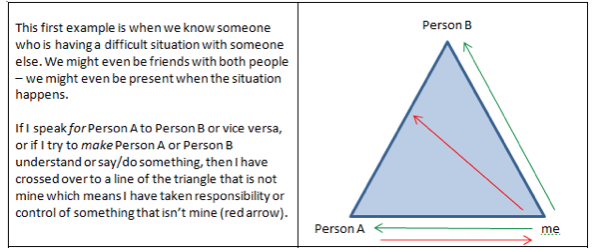
In each example, I am only responsible for and can only control the arrow that extends from me for the line of the triangle that touches me (the green arrows). I am not responsible for, and should not try to control the line that does not touch me or originate with me (the red arrows) – if I do then I have tried to take control/power/responsibility of something that isn’t mine.


Healthy control realizes there are some things that we have control over and some things that we don’t. It causes us to take ownership for our interactions, responses, and growth. While we can speak into the lives of those who have given us permission to speak into them, healthy control does not overstep its bounds in either taking responsibility for things it is not responsible for or in doing things to make another person do or not do something. This means we can say what we think, feel, need and want, but accept the other person’s decision. In situations where their decision impacts us negatively, then we take control of our response and do what we need to keep ourselves safe or meet our need. Healthy control doesn’t need to take control from someone else. 

By Adrienne Kather, LPC